
Beginner Crochet Rose Pattern
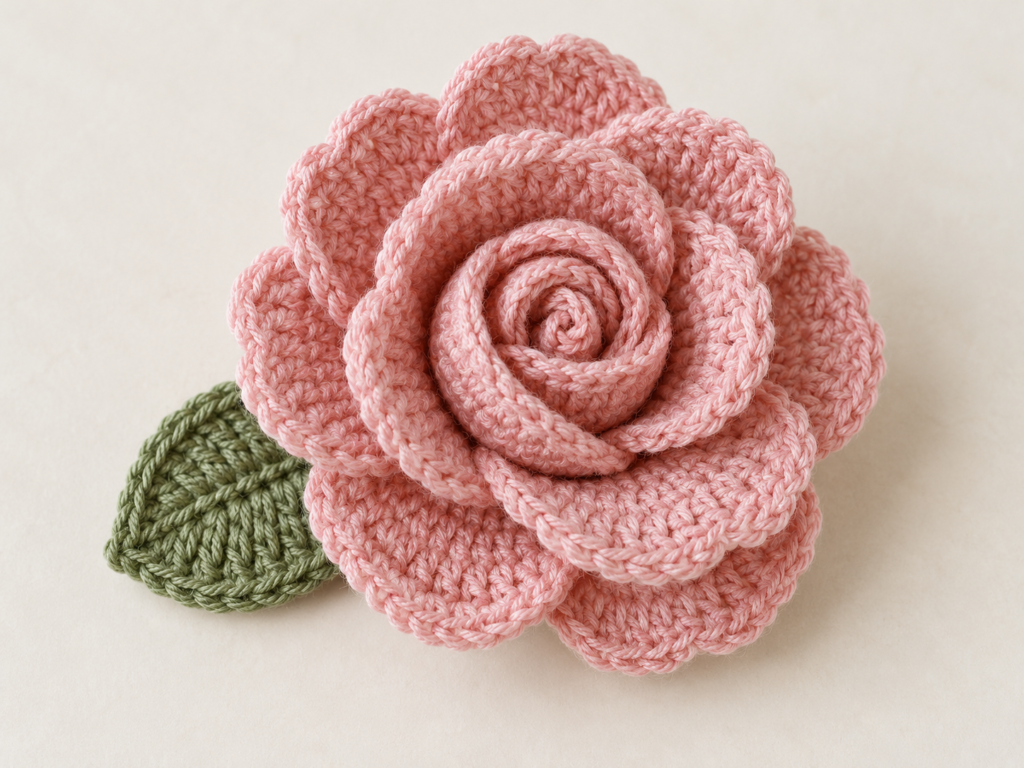
Make a soft blush-pink rose by crocheting a flat strip of petals, rolling it into a flower, and securing the base. This design uses a different construction from the layered circular rose in your reference.
Smaller petals form the center, while larger petals wrap around the outside. Add a sage-green leaf for contrast, or leave the rose plain for a simple floral decoration.
Pattern status: This is an untested draft. Stitch counts have been checked, but the petal shape, finished size, and assembly need confirmation from a crocheted sample.
Materials
- Blush-pink DK yarn for the rose
- Sage-green yarn of the same weight for the optional leaf
- A hook suitable for your yarn; try 3–3.5 mm for the first sample
- Yarn needle
- Scissors
No stuffing is required. Aim for stitches that hold their shape while allowing the strip to roll easily.

Abbreviations
| Abbreviation | Meaning |
|---|---|
| ch | Chain |
| sc | Single crochet |
| hdc | Half double crochet |
| dc | Double crochet |
| sl st | Slip stitch |
| st / sts | Stitch / stitches |
Single crochet: Insert the hook, yarn over and pull up a loop, then yarn over and pull through both loops.
Half double crochet: Yarn over, insert the hook and pull up a loop, then yarn over and pull through all 3 loops.
Double crochet: Yarn over, insert the hook and pull up a loop. Yarn over and pull through 2 loops, then yarn over and pull through the remaining 2 loops.
Pattern Notes
- The rose is worked in rows, then rolled and sewn.
- Each petal uses 3 stitches from the foundation row.
- Turning chains do not count as stitches.
- Begin rolling at the end with the smaller petals.
- This pattern produces a rolled rose, rather than a flower built in circular layers.
Beginner Crochet Rose Pattern
Row 1: Make the Foundation
Using pink yarn, ch 37.
Starting in the second chain from the hook, work 1 sc into each chain.
Count: 36 sc.
Ch 1 and turn.
Row 2: Crochet the Petals
Work the following groups across the 36 stitches.
Small Petals — Make Four
Repeat 4 times:
- Sl st into the next stitch.
- Work 5 hdc into the next stitch.
- Sl st into the next stitch.
These four petals use 12 foundation stitches.
Medium Petals — Make Four
Repeat 4 times:
- Sl st into the next stitch.
- Work 5 dc into the next stitch.
- Sl st into the next stitch.
These four petals use the next 12 foundation stitches.
Large Petals — Make Four
Repeat 4 times:
- Sl st into the next stitch.
- Work 7 dc into the next stitch.
- Sl st into the next stitch.
These four petals use the final 12 foundation stitches.
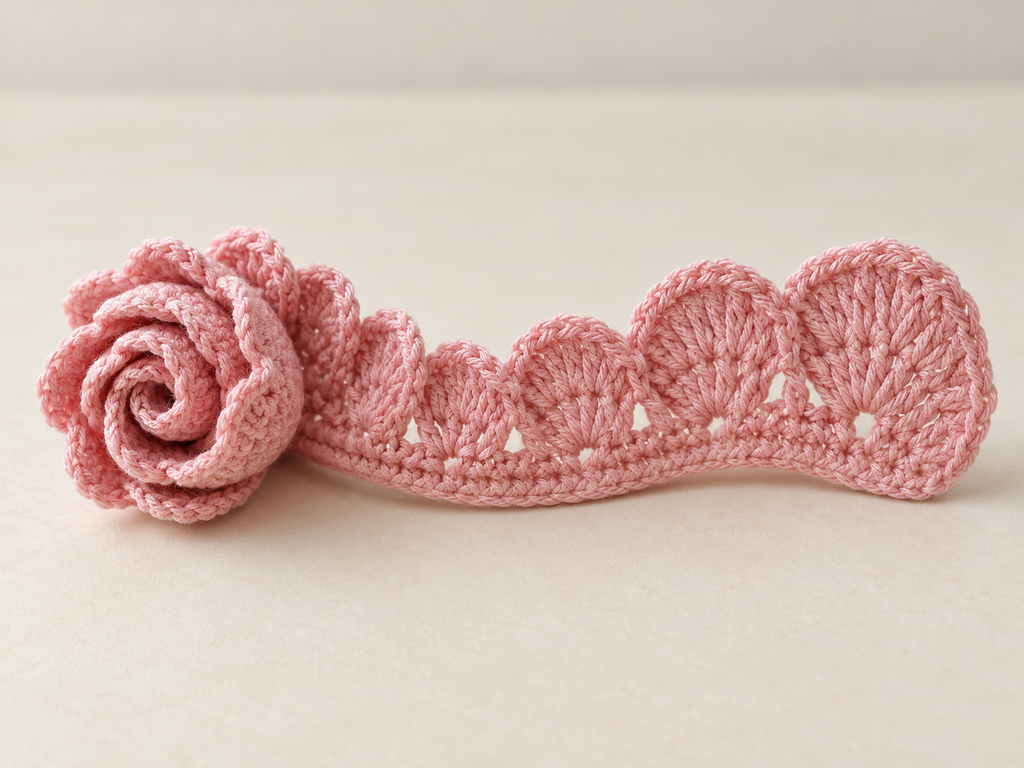
You should have 12 petals in total. Fasten off, leaving a long tail for sewing.
The strip may curl as you work. Lay it out gently without stretching the petal edges.

Roll the Rose
Place the strip with the petals along its upper edge.
- Begin at the small-petal end.
- Roll the first petals fairly closely to form the center.
- Continue wrapping the medium petals around the center.
- Wrap the larger petals more loosely around the outside.
- Keep the foundation edge aligned at the bottom.
Hold the base while arranging the petals. Adjust the overlap until you like the shape; avoid pulling the strip so tightly that the petals disappear into the roll.
Secure the Base
Thread the long finishing tail onto a yarn needle.
Sew through several layers of the foundation edge at the bottom of the rose. Rotate the flower and repeat from different directions so the outer layers are secured to the center.
Keep the stitches near the base rather than sewing through the visible petal tips. Gently check that the outer end cannot unwrap.
Secure the yarn and weave in both ends.
Optional Leaf — Make One
Using sage-green yarn, ch 7.
Starting in the second chain from the hook, work:
Sc, hdc, dc, dc, hdc, sc.
You have worked across all 6 available chains.
Ch 1, then rotate the piece to work along the unused loops on the opposite side of the foundation chain:
Sc, hdc, dc, dc, hdc, sc.
Sl st into the first sc to join. The leaf has 12 stitches, excluding the chain and joining slip stitch.
Fasten off with a sewing tail. Attach one end of the leaf beneath the rose, leaving the rest visible beyond the outer petals.

Tips for Shaping Your Rose
- Use the small petals for the center. This creates a gradual transition toward the larger outer petals.
- Keep the foundation edge level. Uneven rolling can create a bulky base.
- Sew through multiple layers. Securing only the outer end may leave the center loose.
- Adjust before fastening the sewing yarn. Check the flower from above and from the side.
- Keep the outer wrap relaxed. The larger petals need room to spread.
Color Ideas
Blush pink and sage green create a soft floral palette. For another look, try butter yellow with olive green, ivory with muted sage, or coral with dark-green foliage.
Use the same yarn weight throughout your first sample. A thicker leaf yarn may make the leaf look oversized beside the flower.
Frequently Asked Questions
Is this rose worked in rounds?
No. It is crocheted as a strip in two rows, then rolled and sewn into shape.
Do I need a magic ring?
No. The flower and leaf both begin with chains.
Can I leave out the leaf?
Yes. The rose can be used on its own as a decorative flower or attached to another crochet project.
Why does my rose look tightly closed?
Try loosening the outer wrap before sewing. Tight tension in the petal row can also affect how the petals spread.
What is the finished size?
It has not yet been confirmed. Measure the test sample across its widest point after rolling and sewing.
Finish Your Crochet Rose
Arrange the petals, check the base stitches, and hide any remaining yarn ends.
Looking for more inspiration? Browse all crochet patterns →