
Free Crochet Lavender Pattern: Make a Soft Purple Sprig

Lavender brings a different rhythm to a crochet flower collection. Where a sunflower spreads wide and a tulip forms a little cup, lavender reaches upward in a slender column of purple blooms.
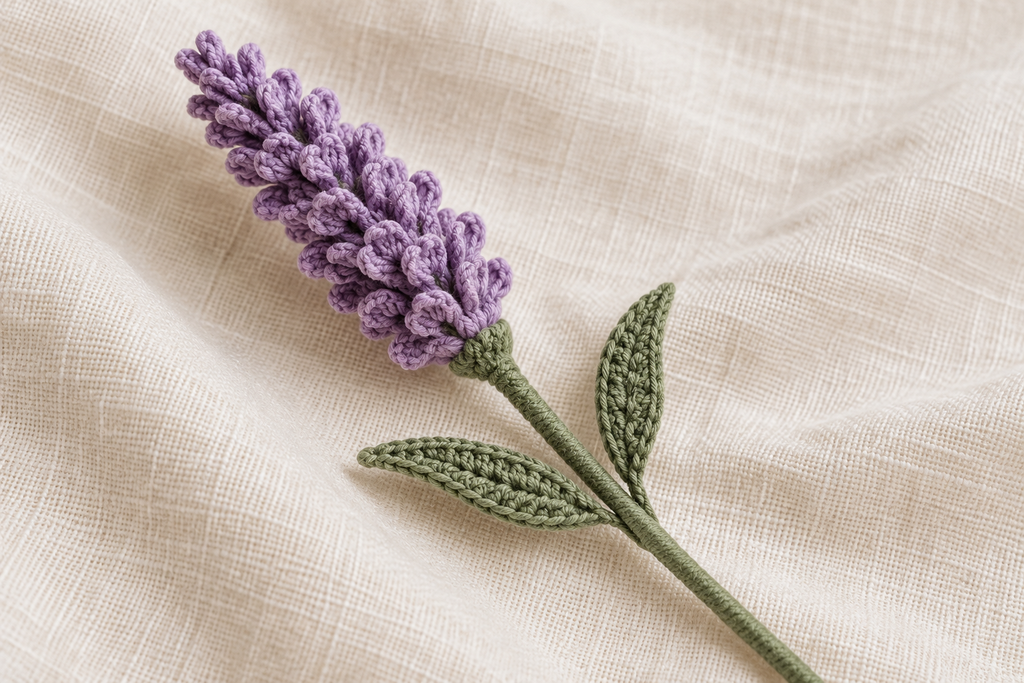
This crochet lavender pattern uses a strip of small flower clusters wrapped around the top of a yarn-covered stem. Two narrow green leaves finish the sprig, giving it a simple silhouette that looks lovely tucked into a small vase or tied onto a gift.
Choose dusty lilac for a gentle look, deep violet for a richer flower, or make several shades for a mixed bunch. The finished sprigs are decorative; they won’t have the fragrance of real lavender.
What you’ll need
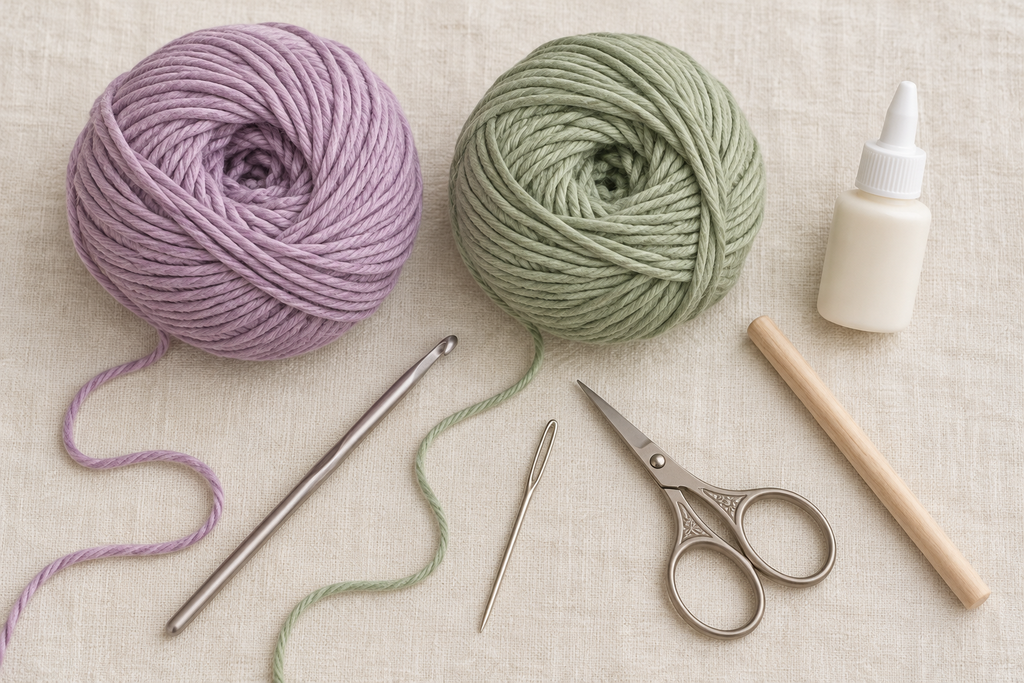
- Purple cotton yarn for the flowers
- Green cotton yarn of the same weight
- A crochet hook suitable for your yarn
- Yarn needle
- Scissors
- A smooth, blunt-ended craft stick or dowel for the stem
- Craft adhesive suitable for yarn and your chosen stem support
Use a stem support long enough to hold the flower section and leave an exposed green stem below it. Cover both ends completely.
Cotton yarn helps define the small flower clusters. Use the same yarn weight for the flowers and leaves so the parts remain in proportion.
Crochet abbreviations
| Abbreviation | Meaning |
|---|---|
| ch | Chain |
| sc | Single crochet |
| hdc | Half double crochet |
| sl st | Slip stitch |
| st | Stitch |
How the lavender is made
You’ll crochet three parts:
- A purple strip with small looped flower clusters
- Two narrow green leaves
- A green yarn covering for the supported stem
Wrap the purple strip around the upper stem in a spiral, then sew neighboring turns together to hold the flower head in place.
Step 1: Crochet the purple foundation
Using purple yarn, ch 25.
Beginning in the second chain from the hook, work 1 sc in each chain across. (24 sc)
Ch 1 and turn. The turning chain does not count as a stitch.
This narrow foundation will form the inner edge of the flower strip.
Step 2: Add the flower clusters
Work the following cluster into the first foundation stitch:
- Sl st into the stitch.
- Ch 3, then sl st into that same stitch.
- Ch 3, then sl st into that same stitch again.
- Ch 3, then sl st into that same stitch once more.
You now have three small chain loops attached to one foundation stitch.
Sl st into the next foundation stitch. This creates a small space between clusters.
Repeat this sequence across the row:
Finish with 12 flower clusters, separated by 12 slip stitches.
Fasten off, leaving a long purple tail for securing the strip during assembly.
Gently separate the three loops in each cluster. Avoid pulling them so hard that the foundation stretches.

Step 3: Crochet two narrow leaves
Using green yarn, ch 11.
Beginning in the second chain from the hook, work:
sl st, sc, 6 hdc, sc, sl st
This uses all ten available chains.
Ch 1, then rotate the piece to work along the opposite side of the foundation chain.
In the ten unused loops, work:
sl st, sc, 6 hdc, sc, sl st
Sl st into the first stitch to join.
Fasten off, leaving a tail for attaching the leaf.
Repeat for the second leaf.
Each leaf has 20 worked stitches, excluding the turning chain and joining slip stitch.

Step 4: Cover the stem
Place a small amount of suitable craft adhesive near one end of the stem support.
Attach the green yarn and wrap it closely around the support, covering the end and continuing down its length. Keep the wraps beside one another so the support does not show through.
Cover the opposite end, secure the yarn, and trim.
Allow the adhesive to dry according to its instructions before adding the flowers.
Step 5: Assemble the lavender sprig
Place one end of the purple strip near the top of the covered stem.
Keep the foundation edge against the stem and the flower loops facing outward.
Wrap the strip downward in a gentle spiral:
- Make the first turn near the tip.
- Continue around the stem, keeping neighboring turns close enough to form a flower head.
- Adjust the spacing so the loops remain visible rather than being crushed under the next turn.
- Use the purple tail to sew neighboring foundation edges together and secure the beginning and end of the strip.
If needed, use a small amount of adhesive beneath the foundation edge to help hold it against the covered support.
Attach the two leaves below the flower head. Wrap their yarn tails around the stem and sew them through the leaf bases and green yarn covering. Position them at slightly different heights.
Allow any adhesive to dry completely.
Tips for a prettier sprig
Keep the chain loops relaxed. Tight loops can disappear into the foundation instead of forming visible little blooms.
Arrange before securing. Try the spiral placement first, then sew it into position once you like its shape.
Keep the purple foundation hidden. The green stem should sit inside the spiral while the flower loops face outward.
Use adhesive sparingly. Too much can soak into the yarn and leave stiff or visible patches.
Let the leaves sit naturally. A slight outward angle gives them more character than pressing both tightly against the stem.
Try a lavender color palette
| Flower color | Stem and leaves | Look |
|---|---|---|
| Dusty lilac | Sage green | Gentle and muted |
| Deep violet | Olive green | Rich and earthy |
| Pale lavender | Soft green | Light and delicate |
| Mixed purple shades | One consistent green | Coordinated bouquet |
For a small bunch, make three or five sprigs and vary the height of the flower heads when arranging them.
Ways to display your crochet lavender
Place a few sprigs in a narrow vase, tie a small bunch with ribbon, or tuck one into the wrapping around a handmade gift.
A single sprig also makes a lovely decorative detail on a shelf beside books or a small ceramic bowl. Keep enough space around the flower head for its clustered texture to show.
Frequently asked questions
Does this crochet lavender smell like lavender?
No. It is a decorative yarn flower with no natural fragrance.
Can I make it without a rigid stem?
You can attach the purple strip to a flexible crochet cord, but the sprig will bend and won’t stand upright in the same way.
Why do my flower clusters look flat?
The chain loops may be too tight, or the spiral turns may be covering them. Gently loosen the arrangement so the loops face outward.
Can I make a longer flower head?
You can extend the foundation using an even number of chains before the turning chain. Each pair of foundation stitches supports one cluster and one separating slip stitch.
How should I clean the finished sprig?
Gently remove dust with a soft brush. Avoid soaking the assembled flower unless the yarn, adhesive, and stem support are all suitable for it.
Looking for more inspiration? Browse all crochet patterns →